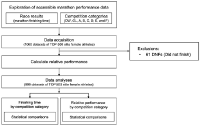
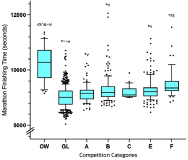
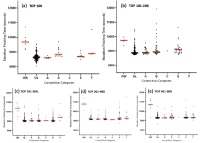
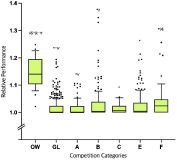
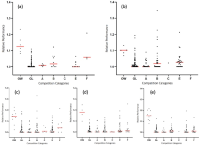
Purpose: We examined the importance of record competition in women’s marathon by comparing and analyzing the records of elite female marathoners for each competition they participated in. Methods: Data of the top 500 female marathon athletes in 2019 were collected from the World Athletics home page (www.worldathletics.org). All competitions approved by the World Athletics were given one of the following categories based on the scale of the competitions: OW, GL, A, B, C, D, E, and F. Race results, relative performances, and the categories of competitions in which subjects participated in were analyzed. Record comparisons were made using one-way ANOVA followed by the Bonferroni post hoc test. Results: There were significant differences in the average record of each category of competition. The average finishing time in GL was the fastest [2:30:26 (± 00:06:29)]. From A to F, average finishing time tended to increase from 2:32:38 (± 00:05:24) to 2:38:17 (± 00:08:27). The average finishing time in OW was the slowest [2:50:36 (± 00:10:48)]. Comparing the relative performances of the athletes in a year, relative performance was faster when participating in large scale international competitions (e.g., GL, A, B, and C), where the primary motivation of athletes is to achieve best records, than other smaller competitions (e.g., E and F), where athletes compete for ranks rather than records (p<.05). However, the relative performance in Olympic Games and World Championships (i.e., OW) was much slower than others (p<.05). Conclusions: These results are interpreted to mean that record competition is better for marathon performance.
The purpose of this study was to investigate the effect of combined static and dynamic stretch as part of warm-up procedures on isokinetic strength, functional movement screen (FMS), flexibility, and agility in Korean national foil fencers. Twelve Korean fencers (mean age 29.3±3.6yrs, Career: 16.6±3.1yrs, Height: 171.4±9.5cm, Weight: 67.3±12.4kg) participated in this study (Male: 7, age 30.0±3.2yrs, Career: 16.7±2.2yrs, Height: 177.1±8.1cm, Weight: 75.1±9.9kg; Female: 5, age 28.4±4.4yrs, Career: 16.4±4.3yrs, Height: 163.4±3.9cm, Weight: 56.3±4.1kg). Fencers measured FMS, isokinetic strength of knee joint, flexibility, agility at pre (1-week) and post (4-week). Fencers performed a warm-up program three times a week for four weeks. As a results, FMS scores (11.8±2.3 to 14.4±1.6, p<0.05), strength of dominant knee flexors (115.5±26.0 to 126.0±26.6, p<0.05), change-step jump (66.0±6.8 to 69.4±5.6, p<0.05), trunk forward flexion (12.0±7.7 to 13.9±6.5, p<0.05) were significantly higher in post-test than pre-test, respectively. However, the results for front-rear step, trunk backward extension were not significant differences between pre-test and post-test. These results suggest that the fencing-specific warm-up program based on stretching is effective on strength of knee flexors, agility by increasing flexibility, improving stability, mobility.
The aim of the present study was to document the process of Long-term Athlete Development (LTAD) adoption by Canadian sport coaches, and to identify predictors of: 1) their attitude and intention to adopt such a social innovation, and 2) their LTAD adoption level. Using Rogers’ innovation diffusion theory, a survey of 499 Canadian coaches was conducted to identify the factors associated with three variables: coaches’ attitude towards LTAD, intention to adopt LTAD, and LTAD adoption status. 279 (56%)(35.4 ± 12.1 years) of them knew LTAD and filled out the entire questionnaire. Perceived knowledge of LTAD, its trialability, observability, intention to adopt, coaches’ certification level, and organisational support were the best predictors of LTAD model adoption level in coaching’ practice (R2=0.579, F9,184=28.32, p<0.001). Coaches in late-developing sports declared having greater knowledge of LTAD, more capacity for its implementation, and lower perceived complexity of application.
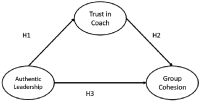
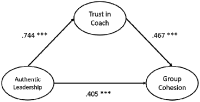
The purpose of this study was to analyze the relationship among players’ perceptions of authentic leadership, trust in coach, and group cohesion. Male college soccer players responded to questionnaire items about these three factors. A total of 249 survey data were analyzed by structural equation modeling. Authentic leadership had a significant positive relationship with trust in coach and group cohesion; trust in coach had a significant positive relationship with group cohesion; and trust in coach was a mediator in the relationship between authentic leadership and group cohesion. These findings suggest when coaches are authentic leaders, athlete and team outcomes may benefit.

As the sport marketplace has become competitive, sport organizations are challenged to attract and maintain sport consumers. Using sport video games as a marketing communication strategy may be a good way to reach young sport consumers due to the popularity of sport video games(SVGs). Based on Kim and Ross’ findings (2006), it is believed that playing SVGs may foster a psychological connection with a sport team. The current study assumes the extent to which motives to play SVGs and a sense of presence contribute to explain a psychological connection with a sports team (i.e., internalization) based on the Fan Attitude Network (FAN) model (Funk & James, 2004). The internalization model of a sport object through sport video gaming is proposed based on the review of literature. The model assumes that motives to play SVGs and a sense of presence contribute to explaining what variables contribute to a sport identity. The purpose of the study is to understand the influence of motives to play SVGs and a sense of presence on a sport identity. A theoretical model depicting the relationship between motives to play SVGs and a sport identity, the relationship between a sense of presence and a sport identity, and the interaction effect between motives and a sense of presence on a sport identity was proposed. Testing the proposed model would contribute to the understanding of what drives sport video gamers to facilitate personal connections with their favorite teams and guide implications for marketing communication practice.
The purpose of this study was to investigate the characteristics of Korean female secondary PE teachers’ voluntary professional development(PD) activity participation in relation to female PE teachers’ perceived professional identity. Data were collected from online questionnaires (n=107) and in-depth interviews (n=15) with female secondary PE teachers. Findings revealed that female PE teachers’ voluntary professional development activities were characterized as: (a) prevalence in sport skill development activities in order to overcome relatively a low level of sport skills than that of male PE teachers, (b) dominance of self-directed learning activities with the Internet search or reading, and (c) seeking ideal mix of theory and practice by participating in teacher learning communities. Female PE teachers’ voluntary PD participation was related to their notion of PE subject as sport skills-centered subject, relatively weak professional identity due to lack of sport skills compared with male teachers, and perceiving teacher learning community as a viable learning context to support their everyday pedagogical PE practice.
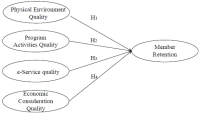
COVID-19 continues to represent the challenge to Taekwondo (TKD) schools. TKD schools have been closed and faced with decreasing participants due to the Pandemic. The purpose of this study is to examine the extent to which service quality factors predict member intention for renewal in TKD schools. The target population evaluated for this study consisted of individuals aged at least 18 years or older who had attended a TKD schools. This study conducted for TKD members in the U.S.. A total of 159 participants were recruited via both in-person and online surveys. This study revealed that TKD members in U.S. of various demographic backgrounds had different perceptions of service quality factors that affected their attendance at TKD schools. The findings of this study will indicate the impact on the satisfaction of various TKD programs and maintenance of membership.
Though the role of emotion has been largely acknowledged across most consumer settings, only recently has this interest transferred to the various contexts in which sports are consumed. The purpose of the present research is to highlight the role of emotions during the viewing of televised sports programming. Across two studies, the manifestation of emotional arousal is empirically established. Additionally, the emotional valence (i.e., the extent to which a stimulus is perceived as affectively positive, neutral, or negative) of marketing stimuli are assessed. A methodology for measuring baseline levels of emotional valence for commercial advertising is outlined. Study 1 is presented in which empirical support is established for the fleeting influence that live sports consumption has upon emotional arousal. This is followed by a review of Study 2, which establishes a methodology for measuring the emotional valence perceived by consumers for embedded commercial advertising. Finally, the practical and research implications of these findings are discussed.
While participating in leisure activities received its notion to help international students’ adjustment process, research regarding the effect of sports spectatorship is lacking. The main purpose of this study is to fill in the gap of the effect of being fans of college sports by examining how international students can also benefit from being fans of college sports for their acculturation. The analysis with 94 international students revealed that their team identification and social activity participation had a significant statistical causal relationship towards acculturation. The study’s implications included utilizing sports spectatorship as a future acculturation strategy for international students.

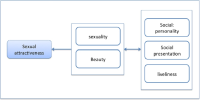
This study explains how women’s football strategically transfers the sports league’s image from hyper-sexualized women’s sports entertainment to the real football league. By focusing on the commercial messages from the Lingerie Football League and the Legends Football League, the author could understand the nature of the sexualized culture as the unique entertainment women’s sports league. By adopting reading sport critically (McDonald & Birrell, 1999), the purpose of this study is to understand the difference between the Lingerie and Legends Football League (LFL). This study further examined how women’s erotic capital performed in the LFL. Thus, in what follows, the author explores the extent to which the LFL strategically manages the mediated athletic bodies—in terms of adornments, types of movement, and media framing—presented to its viewership. In so doing, this analysis looks at the mediated feminine body as it is transformed, made into a site for maximum erotic capital. The findings indicate how the critical perspectives explain the LFL context and provide suggestions for further exploring a newly formed women’s professional sports league.